
home>
poets>
fullname biography








last update:
22 Nov26
e-mail Alex
Alex Josephy website
poetry favourites:
London Grip Magazine online
The High Window archive
The National Poetry Library
Poetry in Translation
The London Review of Books
Poets.org (Academy of American Poets)
Italian Poetry Review
and in the shop…
collections –
“A Little Bridge”
and
“Naked Since Faversham”,
Pindrop Press;
“Again Behold the Stars”
and
“Other Blackbirds”,
Cinnamon Press;
“White Roads”,
Paekakariki Press
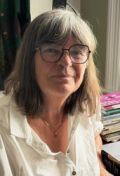
Alex lives and writes in East Sussex and Italy. She has worked as a UK state school teacher and university lecturer and as an NHS education adviser. Her most recent collection is A Little Bridge, Pindrop Press, 2026. She is particularly interested in the inter-connections between different languages and cultures, and in our troubled but vital relationships with the natural world. Other published collections include Other Blackbirds (a Cinnamon Press pamphlet, 2016), White Roads, Paekakariki Press, 2018, Naked Since Faversham, Pindrop Press, 2020 and Again Behold the Stars, (a Cinnamon Press pamphlet award winner, 2023). Her poems have won the McLellan and Battered Moons prizes, have been placed in the Troubadour and Hippocrates prizes, and have appeared widely in magazines and anthologies in the UK, Italy and once or twice in India. As part of the Poetry School ‘Mixed Borders’ scheme, she has been poet-in-residence at Rainham Hall, Essex, and in Markham Square, London. Alex is a poetry mentor and writes reviews for publications such as London Grip and until recently, The High Window and Envoi. She is joint rep for the Hastings Poetry Society Stanza, having co-coordinated the Greenwich Meantime stanza online during the pandemic.
Review comments/extracts:
on A Little Bridge:
A Little Bridge begins with a quotation: “The poem is a bridge, extending across time and encompassing all horizons”, from the Syrian poet Nizar Qabbani. Josephy’s poetry is subtly complex, moving between people, places, and most skilfully exposing the human need to connect. Its keenly observed images and sumptuous language make it a compelling read… This vibrant collection encourages us to savour each moment, each stage of our lives, laid out by a poet with great heart and skill.
Jenny McRobert on Write Out Loud site, September 2026
This is the work of surprise: at once transportive and homely, exotic and humble, sincere and funny. Josephy writes authentically, with precision and confidence. From an introductory Anglo-Italian mosaic of poetic gems laid with deft hands, to haircuts and fish shop encounters, through to the solitude and sanctuary of the natural world, Josephy does it all with skill and compassion.
Vic Pickup, writer and researcher, and co-organiser and presenter at Reading Poets Café, commendation for the book jacket, 2026
The bridges in the collection are of different types, but most importantly the poems are made by an associative language that links reader and poet. I would recommend this book for its thought-provoking perspectives, created by a … poet who communicates in an engaging and memorable way.
Jennifer Johnson in London Grip, October 2026
on Again Behold the Stars:
Emma Storr in London Grip, June 2023
It is in their timelessness that Josephy’s glimpses – scorci – through the arrow slits of lives under siege are given their timeliness. The narrative of these exquisitely crafted poems, with their echoes of sonnets and madrigals, is both meditative and outraged; poems that exist of themselves and yet cohere. At its heart, however, Again Behold the Stars, is an anthem of hope and endurance, is a celebration of the complexity and strength of community and womanhood in hard times.
Claire Dyer, 2023
Ha! According to Silvana
the Florentines’ faces are whipped arses!
Their heads are boiled-dry saucepans
crowned with cuckold horns.
‘Yes, and their broken balls flap
in the breeze,’ trills Ofelia
whose voice is like a throstle’s (Chorus)
Yet it also reaches for the sublime, drawing on the town’s religious or mythical stories, such as in the poem ‘Turn’ with its epigraph of Dante’s 4 final lines from the Inferno from which the title is taken. This poem is written in tercets with an unrhymed suggestion of Dante’s terza rima, and contains the lovely image of the Virgin throwing a blue protective cloak around the town. The last poem ‘Straws’ is less spiritual and more human but nonetheless holds hope for the future: ‘There’s no good news from the watchmen’ but the women are choosing names for a new baby, and the image of the nurturing nest re-appears. Again Behold the Stars is a beautifully achieved collection and an immensely enjoyable read.
Extract from a review by Caroline Maldonado in The High Window April 2023
on Naked Since Faversham:
So many times, while reading, I had to set the book down and spend a few moments considering an image or thinking about the language and nuances of her poems: from ‘Anaesthetist’ where the operating theatre becomes a Boeing 707, to ‘Lizardry’ when the speaker waits in ambush – whatever suns itself in secret, | moves likes lightning |before my ears understand | it’s gone… Over and again, through many poems in the collection, I found myself re-reading her final stanzas more than twice. As a reader I most enjoy a poem that moves me through or toward a place that I might not feel coming until I find myself, suddenly, there. I don’t mean an ending with a twist, but rather a place to which I arrive after being gently nudged toward an idea, a thought, a felt sense, until I encounter a moment that I had just started to sense, but without knowing that the poem would take me there… On the whole the depth of emotion that comes through in her collection really does it for me. By the time I finished reading, I already knew where the collection would live on my bookshelves: right at the top, reserved for poetry-collections-to-come-back-to, alongside my other favourites.
Liz Bahs, 2020, in Outside of a Cat
© Copyright of all poems featured on this site remains with the poet
site
feedback welcome
